
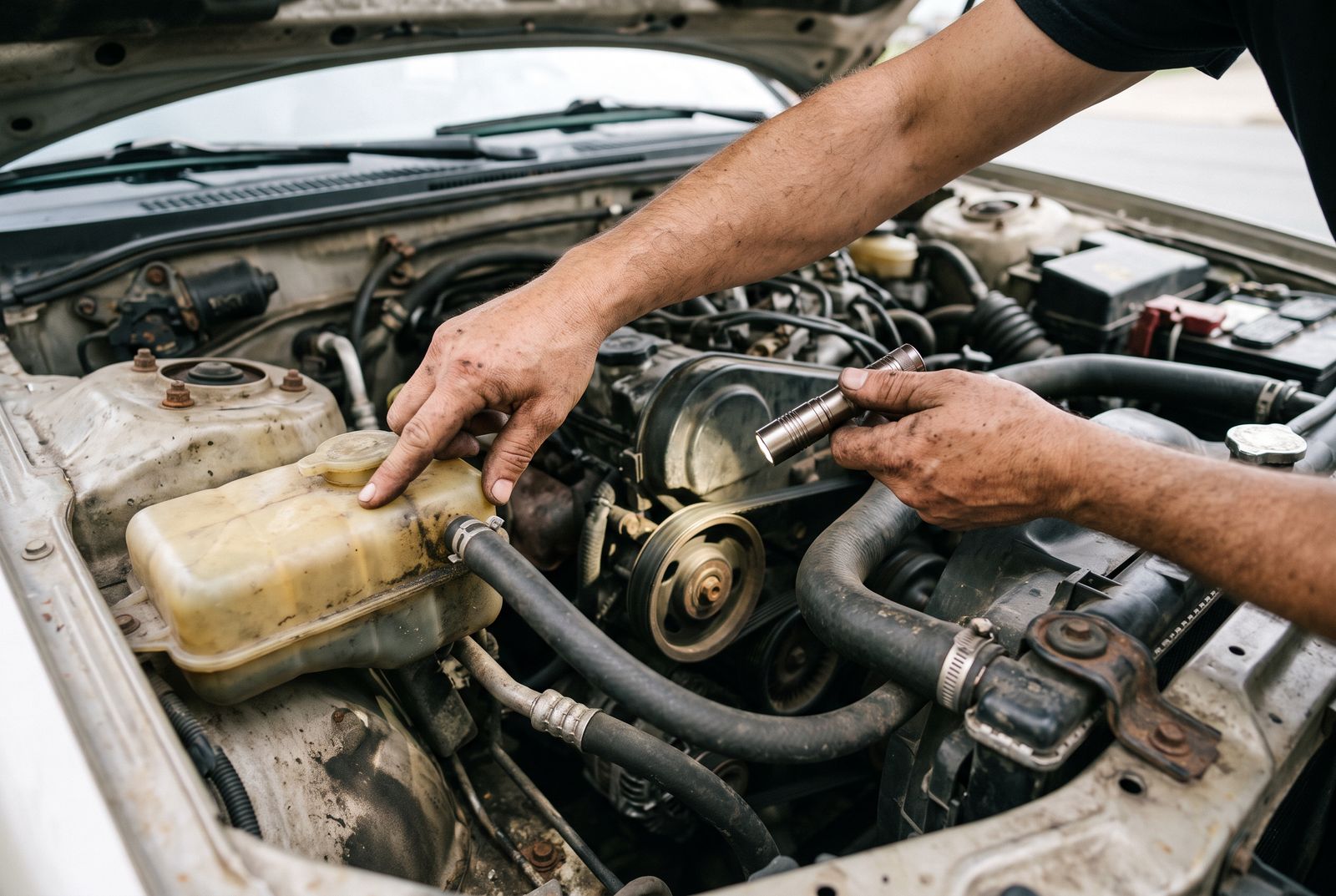
Before you go look at the car
Most bad purchases could have been avoided before the buyer ever left home. Ask the seller for the VIN over text and run it first. A ten-minute check on the federal recall lookup and a title history search can tell you whether the trip is worth making. The history and title checks guide lists which tools to use and what each one can and cannot see.
Then ask three questions by message, so you have the answers in writing: Is the title in your name? Has the car been in an accident or had hail repair? Can I have it inspected by my own mechanic? The way a seller answers is often as useful as the answers.
Pack a flashlight, paper towels, a tread depth gauge or a coin, a small magnet wrapped in a cloth, and a friend if you can bring one. A second person can watch for smoke at the tailpipe during the cold start and check brake lights while you press the pedal.
Ask the seller not to start the car before you arrive. A warm engine hides hard starting, rough idle, timing chain rattle and the puff of smoke that worn valve seals produce. If the hood is warm when you get there, say so and come back another time.
The interactive checklist
Work through the five sections in order. Mark each line as you check it. Anything you mark as a concern lands in a running list at the bottom, ready to read back to the seller or hand to your mechanic. Nothing is sent anywhere; answers are saved only in this browser on this device.
Walkaround and test drive
Why the cold start tells you more than the test drive
An engine that has sat overnight has drained oil back to the pan, has tight clearances and runs a rich mixture until it warms up. That is exactly when worn parts make themselves known. Listen for a rattle that lasts a second or two after start, which on many engines points to a stretched timing chain or a tired tensioner. Watch the tailpipe: a brief puff of blue smoke suggests oil getting past valve seals, while thick white smoke that smells sweet suggests coolant in the combustion chamber.
Denver winters make cold starts a daily event for months at a time, so a car that starts reluctantly in a driveway in October will be worse in January. Battery health matters too. Ask how old the battery is; a weak one shows up first on the coldest mornings.
Using a code reader
An inexpensive OBD-II reader plugs in under the dash on any car sold in the United States since 1996. Beyond stored trouble codes, look at the readiness monitors. When codes are cleared, the monitors reset to "not ready" and take a period of normal driving to complete. Several incomplete monitors on a car the seller says they drive daily is worth a direct question. It also matters for registration: an emissions test can fail a car whose monitors are not ready.
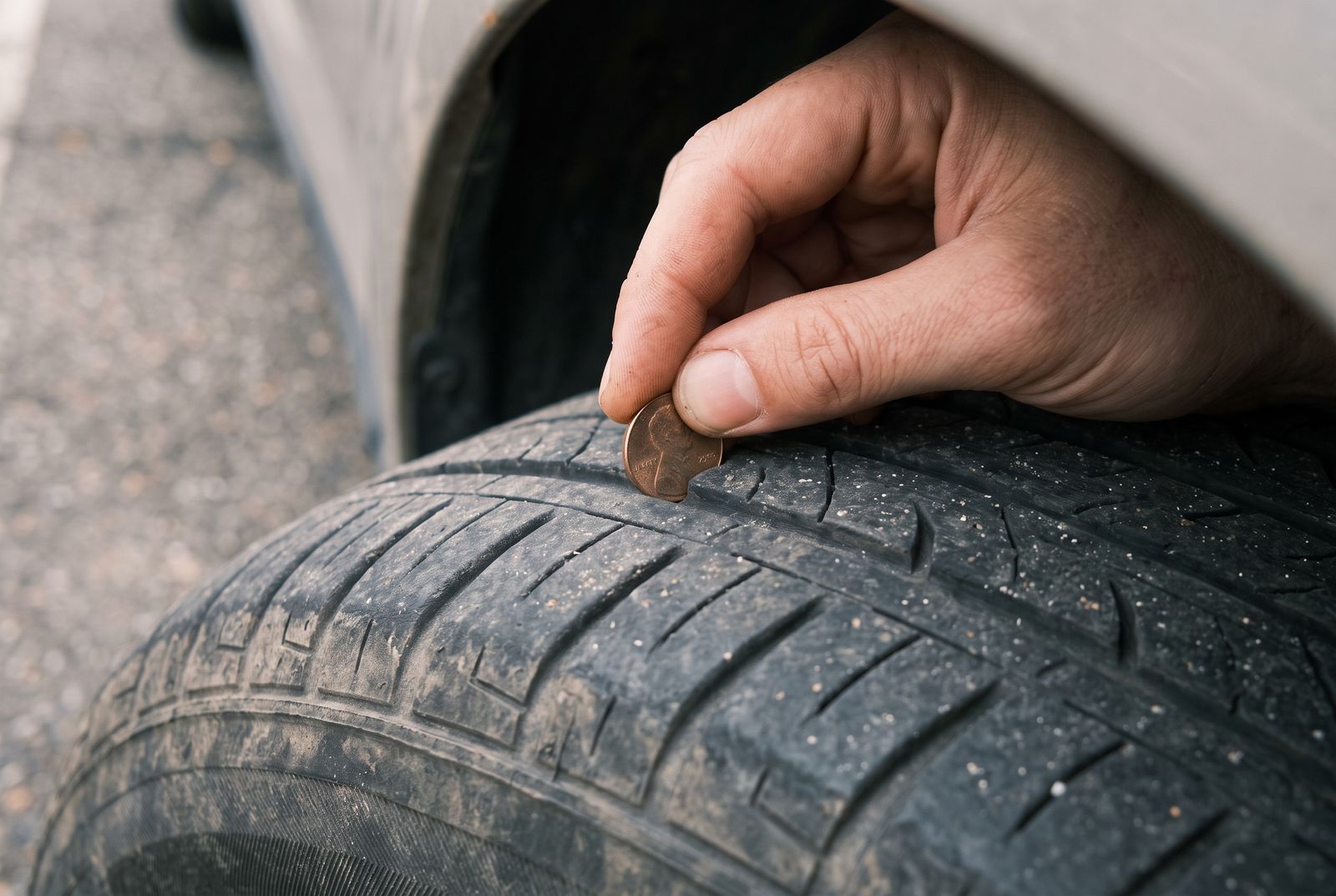
Reading the tires like a mechanic would
Tires are a cheap diagnostic tool. Even wear across the tread with decent depth suggests correct alignment and a careful owner. Wear concentrated on the inner or outer edge points to alignment problems, sometimes caused by bent suspension parts after a curb strike or pothole. Scalloped, cupped wear often comes from worn shocks or struts. Feathered edges you can feel by running a hand across the tread usually mean the toe setting is off.
Depth matters more here than in many places. Colorado's traction law for I-70 and other mountain corridors sets a minimum of 3/16 inch of tread for tires used under the law when it is in effect. If the car's tires are near that line, add a set to your budget. See the Colorado driving guide for how the law works.
On all-wheel-drive cars, check that all four tires match in brand, model and size, and that their wear is similar. Many AWD systems are sensitive to differences in tire circumference, and a mismatched set can strain the center differential or coupling over time. Ask whether the tires were replaced as a set.
Running a test drive that actually tests something
A loop around a quiet block tells you very little. Plan a route that includes stop-and-go traffic, a highway on-ramp where you accelerate hard, steady highway speed, a rough or patched street, a tight parking lot turn at full lock, and at least one firm stop from speed with no car behind you.
- With the radio off, listen for humming that changes with speed, which often points to a wheel bearing.
- In the parking lot, turn the wheel fully each way and listen for clicking from the front axles.
- On the on-ramp, watch for revs that flare between shifts or a pause before the transmission engages.
- At highway speed, note any vibration in the steering wheel, seat or floor.
- Back at the start, leave the engine running and look underneath for fresh drips.
Continuously variable transmissions deserve extra attention. A CVT should feel smooth and continuous; shuddering from a stop, a droning whine that rises with speed, or a sense of the engine revving without the car moving forward are all reasons to stop and get a professional opinion.
Found something you cannot explain?Describe the noise, smell or warning light and the car's year and model. We will tell you what we would ask the seller next.
Ask about itThe professional pre-purchase inspection
Your checklist narrows the field. The inspection from an independent shop decides it. A technician with a lift can check what you cannot: the condition of the subframe and brake lines after years of winter deicer, oil seeping from a rear main seal, torn axle boots, worn ball joints and control arm bushings, and evidence of frame straightening after a collision.
Choose the shop yourself, not from the seller's suggestion. Tell them the year, make, model and mileage, and ask what their pre-purchase inspection covers and roughly what it costs. Ask whether they will scan for codes, check the readiness monitors and give you a written list of findings with estimated repair costs. Bring your concerns list from the checklist above so they can look at those items specifically.
Then use the findings. A clean report is permission to buy at a fair price. A report with a few hundred dollars of upcoming maintenance is a negotiating point. A report that finds frame damage, a failing transmission or a head gasket leak is the cheapest way you will ever avoid a bad car. The budget and fair price guide shows how to turn repair estimates into a counteroffer.
Common questions
Can I do the inspection myself instead of paying a mechanic?
Your own walkaround is a filter, not a replacement. It rules out obvious losers before you spend money on a professional inspection. A mechanic with a lift can see the undercarriage, suspension bushings, leaks and frame repairs that you cannot see from a driveway.
What if the seller wants to bring the car to their own mechanic?
Politely decline and use a shop you chose. The point of the inspection is an opinion that works for you. Call a shop you trust and ask whether they do pre-purchase inspections and how they handle a car the seller drives over.
How long should a test drive be?
Long enough to reach full operating temperature and cover city streets, a highway on-ramp, a rough road and a full stop from speed. For most cars that means at least twenty to thirty minutes. Problems with cooling systems and transmissions often show up only once the car is fully warm.