
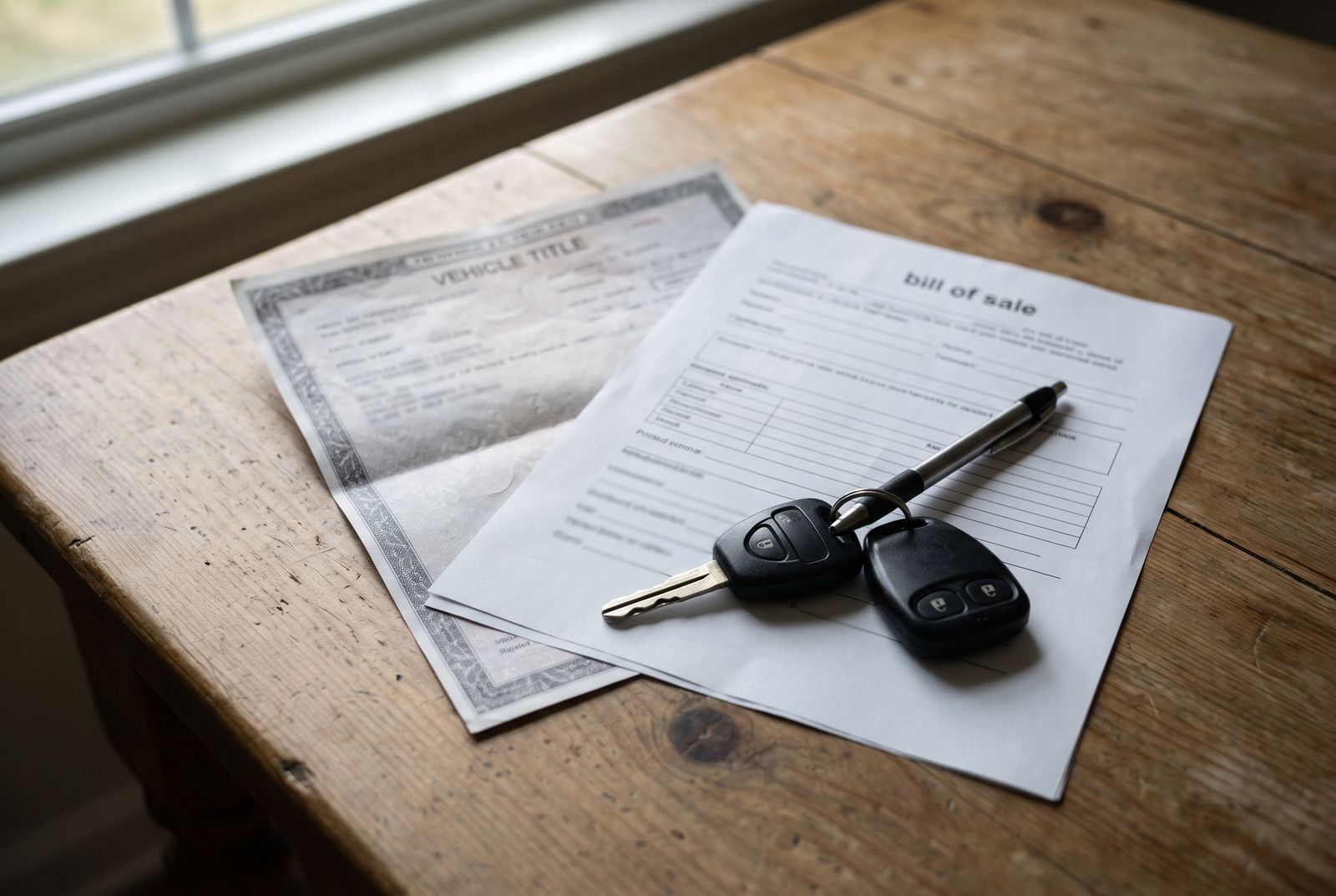
Fees, deadlines and forms are set by Colorado statute and the Division of Motor Vehicles, and they change. This guide explains how the process fits together. Before you buy, confirm the specifics with the Colorado DMV, your county motor vehicle office and Air Care Colorado. Nothing here is legal or tax advice.
The order of operations for a private sale
Most problems come from doing the steps out of order: paying before seeing the title, or driving away before arranging insurance. This sequence keeps you covered.
- Before you pay: confirm the title is in the seller's name, check for a lienholder, and find out whether the car needs an emissions test and whether the seller has a current passing result.
- At the sale: the seller signs the title over to you, and you both sign a bill of sale with the date, price, VIN, year, make and model.
- Before you drive: add the car to your insurance policy and print or save the proof.
- Within the state deadline: take the title, bill of sale, insurance proof, emissions result if needed, and your ID to your county motor vehicle office. Pay sales tax and registration fees there.
Buying from a licensed dealer compresses most of this. The dealer prepares the title paperwork, usually collects sales tax, and issues temporary tags. You still need insurance before you leave the lot, and you should confirm in writing who is responsible for the emissions test.
Getting the title right
The title is the single most important document in a used-car sale. A car without a clean, transferable title is a car you may never be able to register.
- Seller's name
- Must match the seller's photo ID. If it does not, find out why before going further.
- Lienholder
- If a bank or lender is listed, the loan must be paid off and released. Ask for the lien release, or complete the sale at the lender so the payoff and title transfer happen together.
- Brands
- Look for words like salvage, rebuilt or flood on the title. A branded title is not automatically a deal-breaker, but it changes value and insurability, and it should be reflected in the price.
- Odometer
- Federal rules require an odometer disclosure on the transfer for most vehicles under 20 years old. Compare the number to the dash and to the history report.
- Signatures
- Every owner listed must sign as the rules require. Two names joined by "and" generally means both must sign. Do not accept a title with cross-outs or correction fluid in the transfer section.
An "open" title is one signed by a previous owner with the buyer section left blank, passed along by someone who never registered the car. It is a classic sign of an unlicensed reseller. Walk away; you have no clean chain of ownership.
Emissions testing in the Denver area
Colorado runs a vehicle emissions program in the Denver metro and parts of the northern Front Range, administered through Air Care Colorado. Whether a particular car needs a test depends on where it will be registered, its model year, its fuel type and its weight. The newest model years are exempt for a period, and some vehicles, such as fully electric cars, do not need testing.
For buyers, the practical points are these:
- If the car needs a test, the county will want a current passing result before registering it to you.
- In a private sale within the program area, state rules generally place the responsibility for providing a passing test on the seller. Confirm this on the Air Care Colorado site, and ask for the result before you pay.
- A car that fails can need anything from a simple repair to expensive catalytic converter or engine work. A fresh fail is a negotiating point; an unknown status is a risk.
- Recently cleared trouble codes can leave readiness monitors incomplete, which can prevent a pass. That is one more reason to bring a code reader to the inspection.
Air Care Colorado offers an online lookup that tells you whether a vehicle is due for a test and shows its testing history by VIN or plate. Run it before you meet the seller.
Insurance comes before the drive home
Colorado requires liability insurance on any vehicle driven on public roads, and you will need proof of insurance to register. Call your insurer or add the car through their app with the VIN before you hand over money. Many policies give a short grace period for newly acquired vehicles, but the terms vary, so ask rather than assume.
This is also a good moment to get a quote on the specific VIN. A car with a branded title, a high theft rate or expensive parts can cost noticeably more to insure than you expected, and it is better to learn that before you buy.
Registering at your county motor vehicle office
In Colorado, title and registration are handled by county motor vehicle offices on behalf of the state. Denver residents use Denver's motor vehicle offices; residents of Aurora, Lakewood, Littleton and the rest of the metro use the office for their county. Many offices encourage or require appointments, and some services can be started online.
Colorado sets a deadline after the purchase date for titling and registering a vehicle, and late fees apply after it passes. Treat the paperwork as part of the purchase, not something to get to eventually.
What to bring
- The title, signed over to you
- A bill of sale (the DMV publishes a standard Colorado bill of sale form)
- Proof of current Colorado insurance
- A passing emissions result, if the vehicle requires one
- A VIN verification, if the car was last titled in another state
- Your Colorado driver license or ID
- Payment for tax and fees
Taxes and fees to expect
Colorado registration involves several separate charges, and they add up. Plan for them in your budget rather than discovering them at the counter.
| Charge | What it is | What drives the amount |
|---|---|---|
| Sales tax | State and local sales tax on the purchase price. Collected by the dealer, or at the county in a private sale. | Price paid and the tax rates where you live. |
| Specific ownership tax | A Colorado tax charged with registration each year, in place of personal property tax on the vehicle. | The vehicle's original value and its age; it drops as the car gets older. |
| Registration fees | State and county fees for plates and registration. | Vehicle weight, type and age, plus local fees. |
| Title fee | A fee to issue the title in your name. | Set by the state. |
| Late fees | Penalties for registering after the deadline. | How late you are. |
Many county offices offer a fee estimator online. Use it with the VIN before you finalize your budget, then plug the result into the out-the-door calculator.
Cars coming from out of state
Buying a car that was last titled in another state adds a step. Colorado requires a physical VIN verification for these vehicles before it will issue a Colorado title. Verifications can be done by certain law enforcement agencies, licensed dealers and emissions testing stations; check the DMV's current list. If the out-of-state title is held by a lender, the process involves getting the title from that lender, which can take time.
Out-of-state cars deserve an extra look in the history report, too. A flood brand applied in one state does not always survive a retitle elsewhere, which is why the national title database described in the history and title guide matters.
Common questions
Can I drive a car home from a private sale before registering it?
You need valid insurance and a way to show the car is legally on the road. The seller's plates generally stay with the seller in Colorado, so ask your county office about a temporary permit before the sale, and arrange insurance before you drive away.
What if the seller lost the title?
Ask the seller to apply for a duplicate title from the state before you pay. Do not accept a bill of sale alone as a substitute for a title on a car that should have one.
Does a gifted car still need an emissions test?
Testing depends on the vehicle and where it will be registered, not on whether money changed hands. Check the VIN with Air Care Colorado. Tax treatment of gifts is different from a sale; ask your county office what documentation they need.
Paperwork question we did not cover?Tell us the situation: lien, lost title, out-of-state car, gift. We will tell you what to ask your county office.
Send the details